Showing posts with label science. Show all posts

Wednesday, November 9, 2011

Science Tattoos

I've had a fascination with tattoos for awhile; although I'd never get one, I get a kind of voyeuristic pleasure out of seeing other people's and hearing their stories. So I was happy to see a slideshow of science-themed tattoos on the Science Times today, from Carl Zimmer's new book, "Science Ink". These tattoos are also of an impressive design and quality, and many of their owners are (bad-ass) scientists themselves:

Jellyfish

Neural network

Ammonite fossil

The Golden Ratio

[Photos culled from Flavorwire, since the Times wouldn't let me copy theirs]

Murmuration is my new favorite word

Def: a collection of starlings.

Watch the amazing video below--you've probably seen photos of this phenomenon before, but seeing it in action is something else.


The music detracts from the video a little bit, but it's not wildly offensive.

These acrobatic waves occur around dusk as the starlings are roosting for the evening. Their numbers slowly build up over the roosting site throughout the afternoon, as the birds return from foraging. Heading to roost en masse decreases the probability that an individual will be picked off by a predator--each bird mimics the others' movements, avoiding the outside of the cloud or being the first to land. [via The Telegraph]


Also, I may have just ended up in a Wiki-hole of obscure names for groups of different birds. A charm of goldfinches! A parliament of owls!

Tuesday, November 1, 2011

Camera traps track Artic predators, and more

Over at the Science Time's Green Blog, conservation biologist Joe Liebezeit shares his work with the Wildlife Conservation Society. In Arctic Alaska, oil drilling platforms and the roads and pipelines connecting them often increase the presence of opportunistic predators, like Arctic foxes and ravens. These animals are attracted to the areas by roadkill and human food waste, and using nooks and crannies under buildings as homes. 

As adorable as baby Arctic foxes are, it's important to track the increase of such predators, as Alaskan wetlands provide breeding and nesting grounds for many different species of birds. In addition to habitat loss, overwhelmingly high numbers of predators near these oil sites can mean bad news for ground-nesting bird species.

Camera traps are a fantastic aid in tracking predation patterns, and provide some amazing shots (both of species of interest and those less connected to human activity, like snowy owls, and non-predators, such as caribou). So far, the Arctic fox appears to be the most common generalist predator near oilfields, and at another site, Arctic ground squirrels have proved to consume more eggs and chicks than predicted by their primarily vegetarian diet. Check out some camera trap highlights:

Young Arctic foxes at Kuparuk oilfield

Red fox challenging geese

Caribou

A snowy owl eats a sandpiper egg

Friday, October 28, 2011

Quantum Erotica

Alt Text: "Casey moaned as Riley moved away: it was a moan of frustration. 'I thought tonight was sex times night?' Casey said, but Riley was gone, out of the room. A few seconds later, noise from the TV drifted up from downstairs. With a sigh, Casey reached for the smartphone at the side of the bed. Seconds later, a new Twitter post was completed. 'Lol', it read."

The Fabric of the Cosmos

The World Science Festival is holding a special screening of NOVA's The Fabric of the Cosmos, followed by a live conversation and Q&A with Brian Greene and theoretical physicists Leonard Susskind and Saul Perlmutter (Nobel Prize, people). If this all sounds a little heavy for you, the World Science Festival is about making science accessible, so I wouldn't be too worried. Just prepare to have your mind blown by SPACE. Free, but registration is required. Wednesday, 11.2, doors at 8:30p, Miller Theatre (2960 Broadway at 116th Street). 

Thursday, October 27, 2011

Bucky Magazines

Inspired by Buckminster Fuller, Paperlux created this foldable cover for an issue of the German design magazine Novum. So many triangles.


It might not make stuffing a magazine into your bag any easier, but it sure would be more colorful. 

[via Design Milk]

Saturday, October 22, 2011

AMNH Diorama Restoration

The New York Times ran an interesting article on the American Museum of Natural History's $2.5 million project of restoring the dioramas in the Hall of North American Mammals. Even though the dioramas are a favorite of many, I think most people don't realize how much care and talent went into all of the aspects--the taxidermy, landscape paintings, and foreground creation. Since the Hall opened in 1942, things have started to look a little faded (although to be honest, I noticed the wear on taxidermy specimens more at the Natural History Museum in London). It's to be expected, and (many endangered) animals aren't exactly being hunted and killed for museums now. Better to restore than replace, right?

Before and after restoration of the mountain goat

Coyote


"The larger animals, like the bears, are often left in place, with the artists perching on cantilevered platforms to avoid damaging the dioramas’ delicate interiors.  But sometimes even large animals have to come out.  A trio of Dall sheep, for example, will have to be removed and put in a giant freezer off and on for several weeks to kill off an insect infestation in their horns.
Natural history dioramas were developed in the late 19th century as museums began to move away from the practice of presenting taxidermy specimens alone in display cases, like objects of art. At the New York museum, the earliest dioramas were called “habitat groups,” four-sided glass cases of mounted birds with a background painting of their habitat. Under the influence of Carl Akeley, a naturalist, sculptor and taxidermist who came to the museum in 1909, the more modern form of diorama evolved.
That form contains three elements — the animals, the background painting and the vegetation, rocks, soil and other foreground objects. Different artists and specialists were responsible for each, traveling to a location — almost all the dioramas recreate specific locales, often in national parks — to draw sketches, collect the animals and gather foreground material."
I loved being scared by the dioramas as a kid (and still do). I find the largest animals literally breath-taking.
[via Gothamist]

Monday, October 10, 2011

Yo mamma's so fat...

The Q&A section of the Science Times this week tackles the question, "Can human actions cause earthquakes?" Turns out, the answer is yes, and earthquakes caused by human engineering may be more common than we realize. Obviously, some are bigger than others, and human usually cause them in one of two ways. Either the load on the crust is changed (e.g. by adding yo' mamma or artificial bodies of water, increasing the load, or decreasing the load by building quarries and oil fields), or the rock is weakened by interstitial fluid (e.g., adding fluid to deep wells). IT'S SCIENCE.

Thursday, October 6, 2011

The Robot Matrix

From a recent Lapham's Quarterly:


I like that mythological and future robots are included, but the one thing I take issue with is having the Furby so high on the intelligence scale. Sure, they appeared to learn English (i.e., that owner's input [teaching] changed the Furby's output), but really they were all programmed to slowly switch over from speaking "Furbish" to English at a pre-determined rate, regardless of how much one spoke to them. Which makes the whole "banning Furbys at confidential meetings" craze ridiculous for more than just the reason that people were bringing Furbys with them to work. 

Tuesday, October 4, 2011

Partridge Watch '11

Apparently this:


was spotted walking around Greenpoint today. It's believed to be a Chukar Partridge, a gamebird normally found in the Midwest. Someone's lost. [via Gothamist]

Wednesday, September 28, 2011

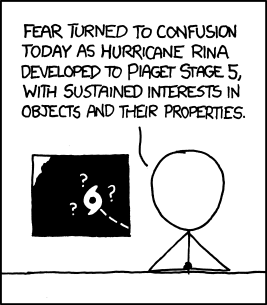
Psychology joke

Hey, nerds!

alt text: "Funding was quickly restored to the NHC and the APA was taken back off hurricane forecast duty."
[via xkcd]

I'm not super interested in dev. psych, but I'll take it where I can get it.

Wednesday, September 21, 2011

YOUTHS!

One of the funniest photo/caption pairings I've seen:

                                 Young people party.

Via NYTimes Dot Earth blog. Teenagers be crazy, for a change.

Monday, September 12, 2011

Pruney is Prudent

The "Really?" section of the Science Times this week tackles an interesting claim: that fingers and toes wrinkle when exposed to water because of water absorption. That's conventional wisdom, anyway. 

There are a couple of questions, however. Why do only our hands and feet prune, and why is the wrinkling most extreme at the ends of toes and fingers? I didn't know this before, but cutting nerves in a finger prevents pruning, and pruning has been confirmed only humans and macaques.

The authors of a recent study in Brain, Behavior and Evolution report that the wrinkles consistently form a pattern of unconnected channels, allowing water to drain away when fingers are pressed to wet surfaces. This permits more contact and, theoretically, increases traction. The authors are planning a future study to examine if wrinkles do indeed create a better grip, and whether mammals in wet habitats show wrinkles more often.


Interesting possible ultimate cause of wet pruning. The more you know!

Wednesday, August 31, 2011

Clever Talk

Oh my god, this is fantastic: Cleverbots having a conversation.

[via Jezebel]

This reminds me of the "Talking to Machines" episode of WNYC's Radiolab. If you're not already listener/free podcast subscriber 1) you should be 2) get this episode. A guy fell in love with a chatbot! Science + sound collages = perfection.

Any excuse for xkcd:

Wednesday, August 24, 2011

Beautiful Brain

As seen on Design Milk, a collection of covers for Oliver Sacks books, created by Cardon Webb.


I love how each cover has its own distinct type/layers of head cross-section, but still form a puzzle together. Although not included in this collection, let me recommend Sacks' book Musicophilia, for a fascinating and easy to understand survey of how our brains interact with music. This includes stories of a type of synesthesia much more interesting than my own.

Saturday, August 20, 2011

smile!

The Green blog on NYTimes.com has a cool post about a global study using motion-sensitive camera traps to estimate mammal populations. It's short and worth the read (and the comment board of the Science Times is a refreshingly thoughtful one). Some highlights from their slideshow:


Mountain Gorillas in the Bwindi forest in Uganda (Wildlife Conservation Society/Tropical Ecology Assessment and Monitoring Network)

Trivia: Mountain Gorillas are the most endangered subspecies of gorillas and are much "furrier" than the ones usually seen in zoos (Western Lowland Gorillas)
!: Mining for and conflict over minerals used in cell phones and other electronics encroach upon Gorilla habitats and increase pressure on vulnerable populations. Maybe don't get a new cell phone every 6 months? RECYCLE ELECTRONICS.

African Elephant in Tanzania (Trento Museum of Science/Tropical Ecology Assessment and Monitoring Network)

A cougar in Costa Rica (Organization for Tropical Studies/Tropical Ecology Assessment and Monitoring Network)